



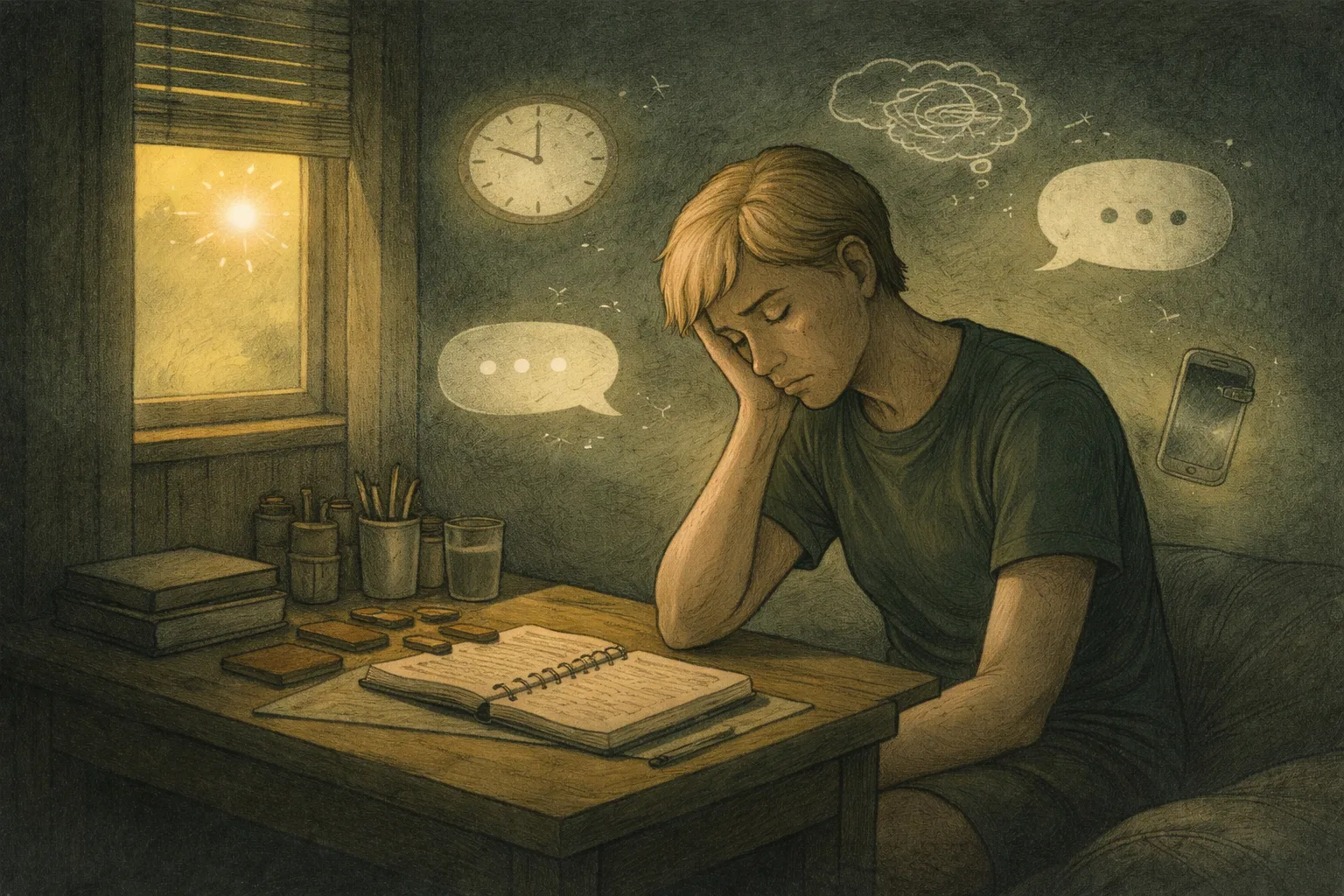
Autistic burnout is a common syndrome experienced by many autistic people at least once in their lives. It often occurs after years of sensory overload and masking—that is, the constant effort to hide or compensate for autistic traits in order to meet social expectations. It manifests as extreme fatigue, but also through a range of cognitive, sensory, and emotional signs that distinguish it from depression or occupational burnout.
I have already explained in detail what autistic burnout is, as well as its causes and how it works, in this article:
Autistic burnout manifests through a series of characteristic cognitive, sensory, and emotional signs. These signs can vary from person to person, but some occur frequently:
- extreme and persistent fatigue
- a loss of cognitive and executive functioning
- increased sensory hypersensitivity
- more frequent shutdowns or meltdowns
- withdrawal and emotional exhaustion
This article describes these signs in more detail.
Very few studies on autistic burnout exist, even though the phenomenon is well documented within the autistic community. A conceptual model was notably proposed by Dora Raymaker and her colleagues in a study published in 2020.
Nevertheless, there is a general consensus about how it typically manifests in most autistic people. It is important to remember that this is not a checklist where every box must be ticked, but rather a possible presentation of autistic burnout.
→ To spot the signs before they become extreme
Here are the most commonly observed signs of autistic burnout.
The signs
1. Extreme fatigue
Burnout often begins abruptly with a feeling of extreme and persistent fatigue that lasts over time, regardless of how much sleep one gets. One may suddenly start sleeping 16–18 hours a day… and still wake up exhausted. I personally experienced several nights in a row sleeping 18 hours without noticing any improvement in my condition. Quite a shock when you consider that I can normally work more than 16 hours a day, as long as it concerns one of my special interests.
This should be distinguished from depression, in which fatigue is also present but is mostly known through its classic representation: the person no longer has the desire or the ability to get out of bed. Burnout fatigue is different in its intensity.
NB: It is common to hear that “sleeping too much is like sleeping too little.” This is false: the brain asks for the sleep it needs. However, sleeping that much is always a signal from the body and brain that something is wrong.
2. Impairment of executive functions
Executive functions include everything that allows the initiation, planning, and organization of daily tasks (as well as working memory, etc.). They are often affected in autistic people (and in people with ADHD). During burnout, they can become drastically weakened, to the point of losing abilities that were previously normal. Cooking, replying to messages, or simply planning an outing can become very difficult, or even impossible.
When I am in the middle of burnout, I can eat the same meal for weeks or months because all it requires is cooking a large quantity of my comfort food: French-style carbonara pasta (some lazy version of the Italian original one).
3. Amplified sensory sensitivities
Almost everyone who has experienced autistic burnout will attest to this: their sensory sensitivities become significantly altered. Whether it affects one sense or several, it can become much more disabling for the person concerned. This is what struck me the most.
I could no longer do certain activities because they necessarily involved surrounding noise that felt overwhelming or sunlight that burned my eyes. I lived in the dark and only went outside in bad weather. Even with sunglasses, a white or blue sky prevented me from risking going outdoors, let alone taking a walk. Living in 2026 is particularly convenient for this, because doing your groceries no longer necessarily requires leaving the house. Imagine that in Roman times, autistic people had to walk all the way to the nearest supermarket.
Burnout also triggered an olfactory hypersensitivity in me, even though my nose had barely detected smells since childhood except for very strong ones such as gasoline. All my other senses were affected in one way or another.
Most importantly, the end of autistic burnout does not always mean a return to normal sensory sensitivities. Mine only got worse. After my first burnout, some friends nicknamed me “X-Men”: I could hear—and still hear, especially when I am close to a crisis—the buzzing of electricity in the walls. And I almost always wear sunglasses, a bit like Cyclops.
4. More frequent shutdowns and meltdowns
Autistic burnout often leads people to experience autistic crises more frequently. I am referring here to shutdowns and meltdowns. Executive function difficulties and sensory hypersensitivities partly explain this.
Outside of burnout, sensory overload, too much social interaction, or an unexpected event can already trigger a crisis, sometimes long and intense. During burnout, the overload is constant. As a result, the person becomes more likely to experience crises.
And since a crisis is exhausting and the nervous system remains overloaded during burnout, the risk of another crisis in the following hours, days, or weeks increases. This can be very disorienting and exhausting for the autistic person. I experienced having one crisis per day for nearly two weeks. My brain was forcing me to stop. My burnout restarted the meltdown mechanism that had calmed down in previous years and accelerated my tendency to shutdown.
5. Partial or total mutism
Some autistic people may temporarily lose the ability to speak. Several factors can explain this:
- executive functions: speaking requires them
- reduced tolerance for social fatigue
- cognitive overload: choosing words and organizing the flow of thoughts related to speech
In such cases, the person may experience partial mutism (for example, only communicating with familiar people) or total mutism depending on their energy level. This is an involuntary phenomenon that can leave the autistic person frustrated or confused.
6. Loss of abilities
What may appear as laziness or inactivity is in reality a sudden loss of abilities that were sometimes acquired through years of effort. It is like a computer that still runs but whose RAM is so saturated that it slows down and shuts down nonessential processes.
Anything can be affected. Masking abilities are often the first to disappear. Reciprocal social interactions may vanish (I functioned only through monologues), social scripts may appear more strongly, and nonverbal communication may become weaker. In my case, even yawning in response to someone else’s yawn disappeared.
Adaptation can also become extremely difficult. Situations that an autistic person previously managed to adapt to may suddenly cause distress or even trigger a crisis during burnout.
7. Social withdrawal
Like a shutdown, autistic burnout often leads to a strong withdrawal into oneself. The person goes out much less and communicates far less with others (sometimes only verbally, sometimes not at all, even by message).
Tolerance for social fatigue becomes extremely low, and even a few minutes of interaction can completely drain the person’s energy. This isolation may be voluntary or involuntary, but it results from a fatigue over which the person has little control. If you witness someone going through autistic burnout, be understanding and do not force them into social activities they cannot handle.
8. Brain fog
This may resemble depression, but the cause is different. In autistic burnout, the person often struggles to process stimuli due to neurological overload. It can feel as if the brain is blocked. I had difficulty making even simple decisions because my special interests monopolized my thoughts while external stimuli were impossible to manage properly.
In depression, we speak of psychomotor slowing (both physical and mental slowing). Slower thinking and difficulty concentrating are typical features.
9. Reduced tolerance for unpredictability and uncertainty
As mentioned earlier, the difficulty managing unpredictability that is commonly found in autism can become extremely disabling. The smallest change of plan may feel unbearable, incomprehensible, or impossible to accept. The person often tries to soothe themselves by repeating questions (often phrased in different ways).
In my case, I came to hate uncertainty. For example, I once followed friends on a walk without knowing how long we would walk. After asking the same question three times in different ways (“How long are we walking?”), I was close to breaking down before a friend finally answered, saying, “You weren’t like this before.” That was a mistake: I had simply learned to cope between childhood and my mid-twenties.
10. Emotional numbness
The autistic brain does not filter much. In addition to sensory stimuli, it often struggles to regulate emotions properly. Emotions may feel more intense and take longer to fade.
When this functioning becomes too prolonged and intense, the brain may switch into a protective mode that I call “emotional numbness.” This can produce a mild feeling of emptiness (to be distinguished from the emptiness associated with borderline personality disorder, which is linked to emotional regulation difficulties and fear of abandonment). Sometimes it feels like a disconnection, but not a dissociation.
(Bonus) Intensification of autistic traits
This is the main difference between autistic burnout and depression. In depression, the key symptom is anhedonia: the loss of interest or pleasure in activities that used to be enjoyable. People say they “no longer feel like doing anything.”
In autistic burnout, people rather say they “can’t anymore.” And we often observe the opposite:
- the person immerses themselves extremely intensely in their special interests, sometimes thinking about them almost constantly; these interests become a refuge for sensory and emotional regulation
- their routines may become even more important and intrusive in daily life
- rituals may also become stronger and more visible
Overall, the person pays less attention to others’ perceptions, their social mask drops, and they may appear “more autistic.”
Final words
If you want to understand in detail what autistic burnout is and how it develops, I have written a complete guide on the subject.
Burnout is a very disabling experience for those who go through it. But it can also mark the beginning of a process of rebuilding: for many people, it often leads to questioning their social circle. Many autistic people stop masking after a burnout, which can cause some relationships to fade away. I experienced this myself and ultimately saw it as something positive. My most understanding friends stayed. The others did not.
Recognizing the signs of burnout can also help you know how to approach the topic with a healthcare professional and sometimes avoid diagnostic wandering. Many autistic people receive an autism diagnosis in adulthood following a burnout, sometimes after it has initially been mistakenly considered depression.
If you recognize yourself in these signs, feel free to talk about it in the comments. I will gladly respond to your questions. However, I remind you that this blog does not replace a consultation with a professional. Information resources also exist for autistic people and their relatives.
If you recognize yourself in several of these signs, it may be helpful to learn about recovery strategies and ways to prevent future burnout episodes.
Recognizing the signs of autistic burnout is an important step in understanding what is happening and adapting your environment.
Frequently asked questions about autistic burnout
Autistic burnout generally manifests as extreme fatigue accompanied by other signs such as a loss of abilities, increased sensory sensitivities, more frequent shutdowns, or brain fog. These signs often appear together after a prolonged period of overload.
Yes. Autistic burnout does not manifest in the same way for everyone. It is rather a set of possible signs whose intensity and combination can vary from one person to another.
In depression, the central sign is often anhedonia, that is, the loss of interest or pleasure in activities. “You no longer feel like doing things.”
In autistic burnout, one more often observes an amplification of certain autistic traits, such as special interests, routines, or sensory hypersensitivities. “You simply can’t anymore.”
Recognizing these signs can be an important first step. It may be helpful to reduce sources of overload, get rest, isolate yourself if necessary, and talk to a professional if the situation becomes difficult to manage. Appropriate support can help you better understand and manage this state.
