
Autistic people are often confronted with the same criticisms: lack of empathy, avoiding eye contact, bluntness, meltdowns, rigidity… In this article, I look back at these common remarks and what they actually feel like when you are autistic.
After an intense episode — a shutdown — that left me unable to function or communicate fluently, a friend told me I should learn to manage my crises so they wouldn’t affect others. Like many remarks directly targeting my autism, I experienced it as a real emotional and cognitive trauma. How do you process, integrate, and understand something that is beyond your control?
In Brief:
- Common criticisms: autistic people are often confronted with the same remarks: “you have no empathy,” “look me in the eyes,” “you should make an effort,” etc.
- Social misunderstandings: many behaviors perceived as cold, rude or rigid are actually linked to autistic functioning.
- Psychological impact: these comments often lead to masking, guilt, social exhaustion and constant self-doubt.
- Purpose of the article: to explore what these criticisms truly feel like from an autistic perspective, through lived experiences.
For a long time, I was repeatedly confronted with remarks about the way I behaved and reacted. Nearly all of them revolved around autism, pointing to traits that had been present in me since childhood — and dismissing them outright. Those remarks shaped the way I interacted with others; they helped build my social mask. A mask so elaborate that it took time for those around me to recalibrate and accept it.
Being autistic often means having to adapt constantly. But sometimes, it also means enduring criticisms that should never exist. Here is a series of remarks I have received — and what they reveal far beyond the words themselves.
You have no empathy
This one is, in my view, the most violent for the person it is directed at. I was once attacked over my empathy… in the middle of a New Year’s Eve party. Imagine a joyful moment suddenly unraveling into a questioning of everything you project to the outside world. On top of having to mask constantly, we are reproached for not doing it well enough. The source of it all: I apparently hadn’t shown enough enthusiasm about a friend’s long-awaited job offer.
In reality, I had fully understood his state of mind and felt the echo of his emotional state but… I failed to produce a sufficient emotional response. The explanation is simple: I didn’t know how much emotion I was expected to express. In the absence of explicit social cues, I therefore appeared apathetic from the outside.
It is worth noting that autistic people are often more prone to very strong emotional empathy, sometimes even more intense than average. Several studies distinguish cognitive empathy — mentally understanding another person’s emotional state — from affective empathy, which refers more to emotionally feeling that state oneself. In autistic people, the former may be impaired while the latter remains intact, or even heightened in some cases (see Affective and cognitive empathy in adolescents with autism spectrum disorder and Prosper Health – Autism and Empathy).
I felt emotionally sealed off at every funeral I attended. And yet, I deeply felt the despair of every person present during the ceremony. At times, it even felt as though I was experiencing their emotions in an amplified way — an impression that echoes certain works describing a form of emotional hyper-reactivity to other people’s distress in some autistic individuals (see Empathy in autistic people).
You should learn to manage yourself
This criticism is particularly dangerous as well. It led to me being made to feel guilty for actions that were outside my personal control. Receiving that remark felt like a stab to the heart. It was like being held responsible for neurological reactions that do not depend on our will.
After masking for nearly 20 years, when I received that comment, it felt like a whip across my back that left lasting marks and scars. I was literally being told to manage the unmanageable. An absurd idea — you can imagine. For me, it translated into an even stronger push to outperform what I was already doing: to eliminate any possibility of an autism diagnosis by suppressing my symptoms and autistic traits. My high intellectual potential then kicked in and dramatically boosted my ability to function socially, masking every autistic trait.
Going through a crisis had become a social risk; I had to hide it at all costs. Even though I was the first victim of it, what I heard in that criticism was the idea that I also had to protect those around me. A challenge. In a context where forced social isolation overrides every primary need, how can one force socially acceptable behavior solely to satisfy the allistic imagination?
It is therefore important to remember that when an autistic person experiences a crisis, they are not responsible for it. They are its victim. Any impact on those around them is merely a subtle manifestation of a state of distress that leaves the person confused and exhausted — drained of all energy. What they need most is simply understanding from those around them.
You should make an effort to adapt
This is one of the most common criticisms experienced by autistic people — and by me. In a world where we constantly strive to adapt to one that is not built for us, we are still often met with a refusal to acknowledge that our efforts are already enough. I once heard this from a close friend, and it left me stunned. How do you respond to such a blunt form of irrationality that assumes the allistic person is the only one making efforts to bridge the gap?
Worse still: what do you say when you know the efforts made by the autistic person often far exceed those required of the allistic person — efforts that, for the latter, rarely threaten their ability to function in society? It is important to understand that the efforts made by autistic people are regular, constant, and imposed. In a world where they may represent only 1 in 150 individuals, they are often the ones carrying the greatest burden of adaptation. Asking them to shoulder an even greater share than what society commonly expects only adds a mental load that can ultimately break their ability to function.
It is therefore essential to respect each person’s limits and capacity to cope.
Look me in the eyes
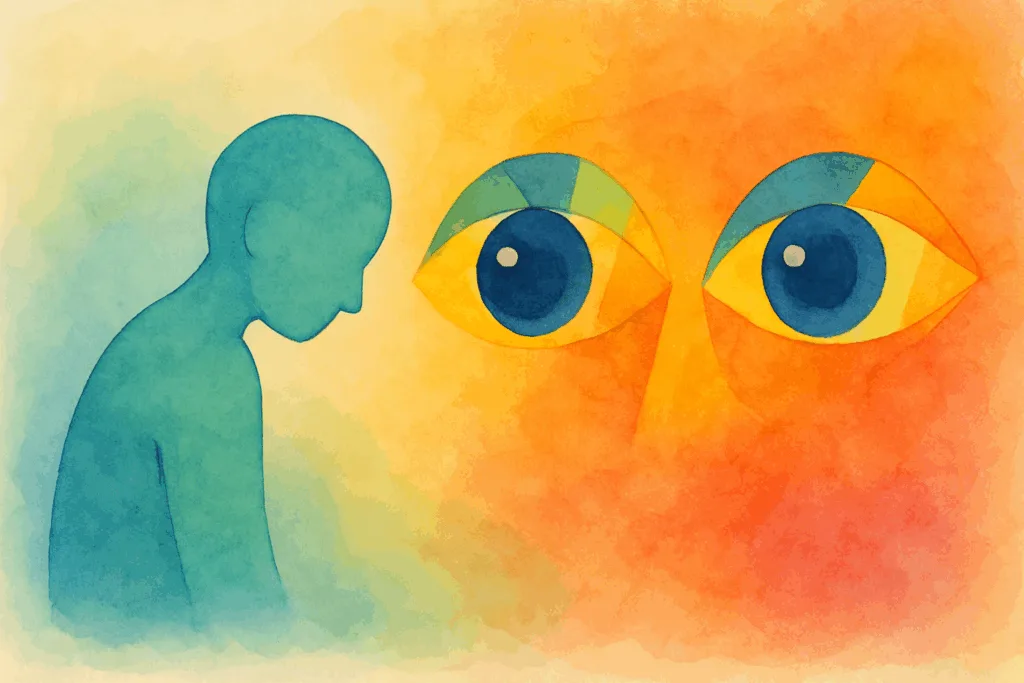
This one is common. Autistic people are often told to look their interlocutor in the eyes. While some can force themselves to do it, many are simply put into distress. The reasons are multiple: social anxiety, visual sensory overload. This last point is rarely discussed: looking at someone’s face — especially their eyes — can put an autistic person into visual overload. I am personally concerned by this.
A great deal of information is conveyed through facial expression, and monitoring each of these movements can quickly become overwhelming for an autistic person who is hyper-vigilant about their surroundings. That is why they often prefer to let their gaze rest elsewhere: on a pattern, a detail, and so on.
I can only confirm how relieving it is to have friends with whom eye contact is not a requirement, but an option. I have had entire conversations with some friends where eye contact served only one purpose: to check the other person’s attention. And it was extremely satisfying and calming.
You’re hurtful (blunt honesty)
This point is important because it is often what most people expect in social interactions. Yet when blunt honesty comes through unfiltered, it is often perceived as tactless or rude. It frequently leaves autistic people confused, because they are simply applying communication rules they were taught early on.
I still have a vivid memory of a loved one coming back from the hairdresser with a brand-new haircut, and of me responding with complete honesty — without considering their different perception — in a way that came across as hurtful. The confusion? Not understanding why my honest comment had been misinterpreted.
This is often where friction arises between autistic and allistic people: communicating without conflict requires recognizing that the other person may not have the same information — or the same ability — to interpret words and gestures in the same way.
It’s up to you to adapt
In a world where I am constantly adapting just to blend in — and where that adaptation is deeply exhausting — I have repeatedly been blamed for causing discord or conflict. I should have done more. Others, supposedly, are constantly adapting to me. What they struggle to grasp is that their adaptation is far less costly and far less constant than the one life has forced upon me.
Each remark of this kind feels like a stab to my conscience: I am already doing it — but not enough. And once again, it is my fault, because others understand each other just fine.
You’re always justifying yourself
No — I’m explaining myself. There’s a difference. Allistic people often seem to struggle to see that nuance, even though it is very real. Justifying yourself is an attempt to excuse a behavior, whereas explaining is simply sharing information, often to foster better understanding in the other person.
I remember my driving lessons with an instructor who simply decided to drop me as a student because, in his view, I was justifying myself and not listening to him. Had he paid even minimal attention, he would have seen that I was improving with every lesson (which contradicts the idea that I wasn’t listening) and that I was simply trying to communicate my difficulties through explanations — sometimes lengthy ones. I was deeply shaken by it, as it was the first time a teacher/instructor/etc. had rejected me. I have encountered this accusation of “justifying myself” many times, and most of the time, it was irrational.
You could have warned us before leaving like that
What this really means is that I was being blamed for quickly removing myself from a situation I perceived as dangerous — at a moment when I likely didn’t have the resources to warn anyone. I received this remark once after abruptly fleeing a party without telling anyone, the door slamming loudly behind me (which was not my intention).
The comment nevertheless echoed like a reproach for not functioning “normally,” even though I myself was in a state of cognitive and emotional distress.
You always want things done your way
In short, when this happens, it is likely tied to my neurological functioning. It’s not that I want things done my way — it’s that I need them to be. I struggle with cognitive flexibility and rely heavily on rituals, routines, and rigid patterns of thought. It’s simply my brain at work, trying to conserve energy.
An unexpected change of restaurant — when we usually go to the same one every week — is perceived as a risk for me: What about the food? The service? The preparation time? And therefore, how much time do I need to plan for this new place?
You never listen to anything
What if we looked at it differently: “I never express myself in the right way for you to listen”? I’ve heard this remark countless times, and yet there is some truth behind the misunderstanding. My attention is not always directed in the typical way and is more likely to falter when instructions are given orally, which can make it seem like I’m not listening at all. Yet I am listening — I just don’t always react outwardly.
One could just as well argue that allistic people don’t listen either, given how many times I’ve had to repeat my explanations about my differences before they were truly understood.
You talk too loud / you behave badly
This assumes we all share the same understanding of what “behaving properly” actually means. It’s full of implicit expectations. The situation becomes even more confusing when I’m told it’s not acceptable to speak loudly while saying what I think, even though — from my perspective — no one around me seems to be paying attention to what I’m saying. On top of that, I often have no idea what I supposedly said that was socially inappropriate.
This is a recurring criticism for me. I’m consistently left in a state of confusion because the criticism comes without explanation. As for speaking too fast, I don’t blame anyone for speaking too slowly. It’s a two-way issue, and I don’t see why I alone should be held responsible for it. If someone kindly and tactfully asks me to slow down, I will do so without any problem. Being reproached for it is what feels troubling.
You’re arrogant / conceited
If I talk about my ease in a particular field, it is far from an attempt to show off. It is simply stating a reality: I have abilities in certain areas that may seem above the norm. This is not arrogance — it is an observation based on years spent alongside people supposedly at a similar level, without ever really seeing it confirmed.
This criticism often surfaces when I discuss my programming skills. For a long time, I never brought them up myself — until I noticed I was consistently ranked at the top of my cohorts without putting in noticeable effort, treating my studies like a game where the goal was to beat the high score.
I didn’t invent anything; experience simply showed that I had a certain level of ease in a field where that level is relatively rare. I am not in denial: I fully know there are developers far more skilled than I am. I am merely stating an observation based on the circles I have been part of. And at the same time, I readily acknowledge all the other areas where I struggle.
Don’t use that tone with me
What tone? Apparently, I had taken on an annoyed or fed-up tone — even though that was absolutely not what I was feeling. Yet allistic people tend to interpret our reactions through their own lens. Any tone that falls outside the norm rarely escapes their notice.
So I do sometimes get this remark, which — ironically — is what actually ends up irritating me. What could be more frustrating than being assigned an emotion that isn’t real? Given that I myself struggle to interpret other people’s tone, I don’t recall ever saying this to anyone. If I’m truly annoyed, it will be very obvious — because I will say so.
You always want to be right
In reality, I rarely speak on topics I don’t understand well. It’s not about wanting to be right at all costs. It’s simply that I am often right when I discuss subjects I’ve thoroughly researched. Prove me wrong — I’m genuinely open to it. And I will readily acknowledge my mistake without hesitation.
Rather than mere tolerance — rather than constant comparison — the autistic community asks for one thing: broader acceptance of its uniqueness. Instead of viewing it through a purely medical or corrective lens, it calls for a perspective that is understanding and supportive.
None of these criticisms helped me get better. All of them made me doubt myself. Being autistic is not a lack of effort; it is living in a world where every effort remains invisible as long as it doesn’t look like everyone else’s.