



“What do you think about the outcome of these tests?” the neuropsychologist in charge of my IQ assessment asked me. I will always remember that moment. At that instant, I hoped that identifying giftedness would be enough to rule out the bipolar cause. So I answered, naturally, that I suspected a confirmation of giftedness. I was right. I was formally identified as very highly gifted by a neuropsychologist… and I believed it would resolve all my difficulties.
I was wrong: giftedness was not going to invalidate anything, because none of its alleged signs could negate real and dangerous symptoms. But the damage was done: upon receiving the identification, I stopped all my treatments and developed my first mixed episode.
The giftedness hypothesis had been suggested by my best friend at the time. Himself very highly gifted with his own difficulties, he had suggested that bipolar disorder might be an unfounded diagnosis and that my mood swings might instead be due to the emotional mismanagement commonly attributed to gifted individuals. Not only has no study ever confirmed this characteristic in gifted people, but I was not experiencing “mood swings” — I was experiencing episodes that put me in daily danger.
Taking the tests like a game
When I decided to take the tests, my goal was not to be identified as gifted — I didn’t really care. I simply wanted an answer. I saw the test as a game, a challenge to succeed at. I was passionate about psychology, so it was a direct extension of that interest: to experience an IQ test myself.
Tests that did not surprise me
But to follow his recommendation and those of others around me, I turned to a neuropsychologist recommended by someone close to me, and after an initial anamnesis interview, I found myself facing the IQ test. It should be noted that I was familiar with some of these tests because my first psychotic episode had involved online IQ tests (which are not worth much, but when they show extreme results — as was my case — the question arises).
Good faith
So I arrived almost cheerful at the idea — not of succeeding at these tests, but of trying to give my maximum to obtain the best scores. This burst of goodwill was even noted in my report, mentioning that I was very willing to go through the tests. The assessment therefore proceeded, in several subtests (subsections within a broader category).
Striking ease
The further the tests progressed, the more I noticed my ability to answer them with ease, always viewing them as a simple game.
Side note: my opinion on these tests
It is very radical: when misused, they become a trap for people who get caught by the charlatanism of psychologists who have figured out how to profit greatly from inventions not supported by science around a certain reality. We know that neural connections tend to be faster as IQ increases, which makes reasoning quicker and more efficient. However, nothing has ever confirmed the characteristics commonly claimed online. The test itself is not the problem (it has its usefulness). Its marketing use is.
So I’m going to briefly describe these tests (training for them is counterproductive and science has estimated that it doesn’t affect scores much, so I’ll allow myself to spoil them). Clarification: I am not showing off — quite the opposite. Despite high scores, I have a certain bitterness toward these tests and especially how the world uses them as a business model. What matters is not the overall IQ score, nor comparing your score to someone else’s. For those who want to take the test, keep in mind that the essential thing is to discover your cognitive strengths and weaknesses. There is no good or bad score. Simply different profiles.
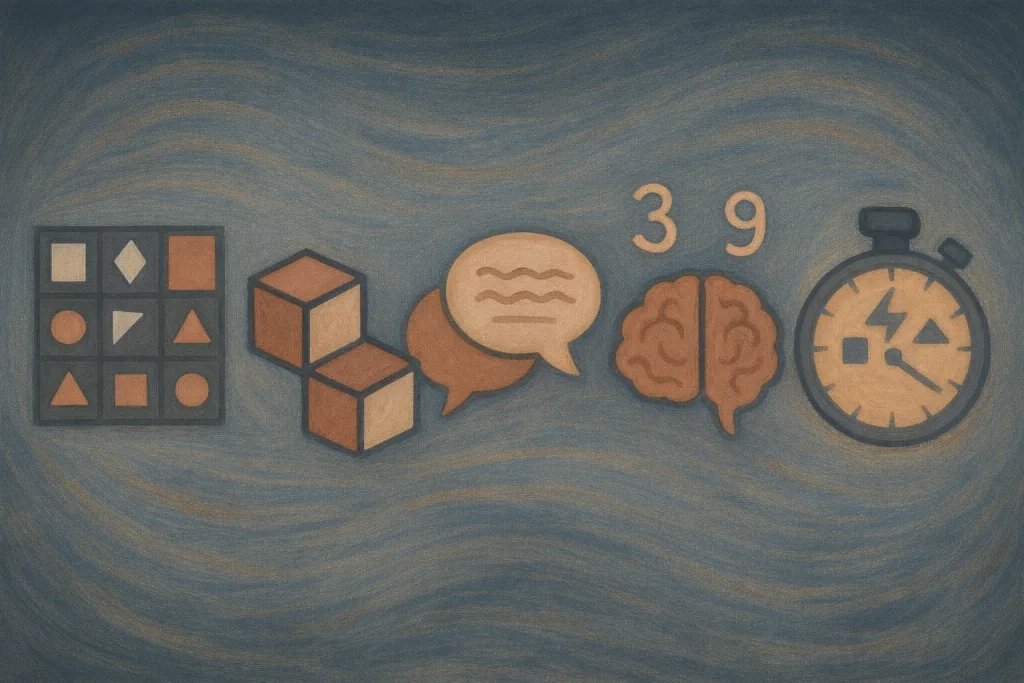
I’ll describe the WAIS-IV, a widely used standardized assessment of adult cognitive abilities.
Perceptual reasoning
Starting with the Raven’s matrices test (logical pattern sequences), easy (but imperfect)… but not my highest score. Matrices are logical sequences of three sets of geometric shapes that must be completed. With my pattern-based thinking, I handled it like a pro (with lettuce, tomato, onions).
Next came the block design test, which requires assembling cubes to reproduce a given pattern. It evaluates spatial orientation. Being pretty terrible in this area, it was the only score that barely exceeded the norm.
Verbal comprehension
Unsurprisingly, these were the tests I performed best on (achieving the maximum score on two of them). These tests assess the ability to make connections between various more or less similar terms, test vocabulary, and so on. Some studies claim that autistic individuals often excel in this domain.
Working memory
Also very high, my scores showed strong abilities to mentally calculate complex operations and juggle information in my head without needing visual support. This is a test that is generally less successful for people with executive dysfunctions such as autistic individuals and those with ADHD.
Processing speed
This tests the ability to process information quickly by reproducing shapes. People with ADHD often struggle with this test, and autistic individuals, who are detail-focused, are at risk of underperforming because they take more time to complete the exercise as accurately as possible, even though they are timed.
Disorders that affect results
If I’m explaining all these tests to you, it’s precisely because people with neurodevelopmental conditions often have difficulties that can bias the results. It is therefore important to understand that these tests were designed by neurotypical people for neurotypical people. They do not take neurodiversity and the potential difficulties that come with it into account.
Moreover, in the WAIS-IV, a list of patterns is suggested to screen for potential disorders based on the scores obtained. Very low processing speed compared to the rest → potential ADHD, if accompanied by difficulty staying focused throughout the test.
NB: the qualities of a good neuropsychologist
I remember seeing my neuropsychologist validate an answer she considered brilliant on my part, because I couldn’t find the answer and had approached the problem from the opposite direction to eliminate the wrong options and find the only possible one. That is the mark of a good neuropsych: they take the overall reasoning into account rather than focusing strictly on the answer and the usual reasoning path. My answer was correct, regardless of the method, so I moved on to the next level.
Another quality of a neuropsychologist is the ability to adapt. I was in good shape for this test but much less so during my second assessment for the autism diagnosis, and the neuropsychologist allowed me to take a break when she saw how exhausted I was. Normally, the test does not allow breaks.
A few words after the test
At the end of the assessment, after asking for my opinion on the test, and without doing any calculations, she immediately told me that I had scored far above the required thresholds. I returned shortly afterward to formalize the identification. I announced the news to those around me because I mistakenly believed it would invalidate my bipolar diagnosis. I immediately stopped my treatments and… experienced my first mixed episode, which left me in severe psychological distress to the point of traumatizing me. I still think about it today. The thought saddens me. Anxiety, loss of bearings, suicidal thoughts — all of this stemmed from misguided advice around me. At least one thing was certain: I did indeed have bipolar disorder (if any further proof had been needed).
Armed with this identification, I dove into articles and books about giftedness… and that’s when I discovered a whole other drift.
Giftedness, a business without scientific foundation
After this identification, I started reading every psychologist’s article on the subject without ever questioning them. That was a mistake. Some of the characteristics attributed to gifted individuals in these articles:
- Intolerance of injustice
- Hyperesthesia
- Overactive imagination
- Strong observational ability
- Attention to detail
- Often described as “too much”
Does this sound familiar? That’s normal: these are all typical characteristics of autism. One study looked into the issue by assessing the IQ of a cohort and administering autism screening tests (AQ, EQ, SQ). Unsurprisingly, they obtained scores above the minimum threshold required. The study suggested that they should undergo a formal autism diagnostic procedure, which would better explain their difficulties.
Today, I use the term VHIQ (very high IQ) when necessary, as it seems more neutral in its implications. For simplicity in this article, I am indeed referring to giftedness. And mine doesn’t interfere with my identity.
Toward autism and beyond
I eventually came to understand that all of this rested on nothing solid, I questioned everything, and it led me to an autism diagnosis. Today, I no longer mention this part of myself, because it seems unimportant to me. It made my life easier, especially academically (until I hit my limits), but that was it. I even literally burned my report when I discovered the deception after a meltdown (spoiler alert: I had scanned it beforehand — because I scan everything — and forgot I had done so, so I still have a copy).
However, after this identification, I learned that many people around me had considered me “gifted” because of my somewhat out-of-the-ordinary programming skills. All of this was better explained by autism than by giftedness alone (perhaps both together, in the end).
Giftedness at the origin of my social mask
Some studies confirm that autistic individuals with a high IQ have better abilities to compensate for their difficulties and to mask them. The higher the IQ, the more effective the mask — and the higher the risk of burnout. When I think that women are already pros at masking, I wonder what happens when they also have high intellectual potential. Real actresses. Except they don’t get paid for it.
Talking about this stage of my journey is therefore necessary because it led me to build a very solid social mask and ultimately brought me to autistic burnout.
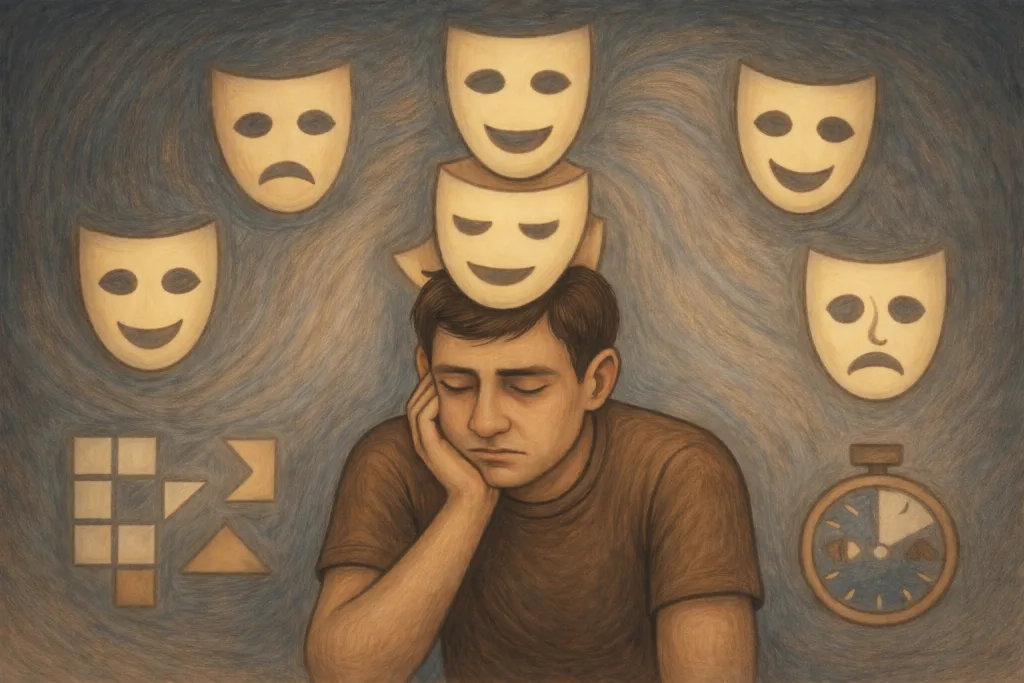
This giftedness therefore did not resonate as the explanation for all my problems. It was only a first sketch. Hypersensitivities, injustice, social masking — all terms that giftedness had been covering up in place of my autism. After several years of absorbing the words of psychologists’ articles, which had turned giftedness into a very lucrative market, I finally questioned everything around the age of 25, during a first burnout. What I had taken for a “definitive answer” was in reality only a step. The real explanation would reveal itself later, with a word I did not even dare to consider: autism.
