



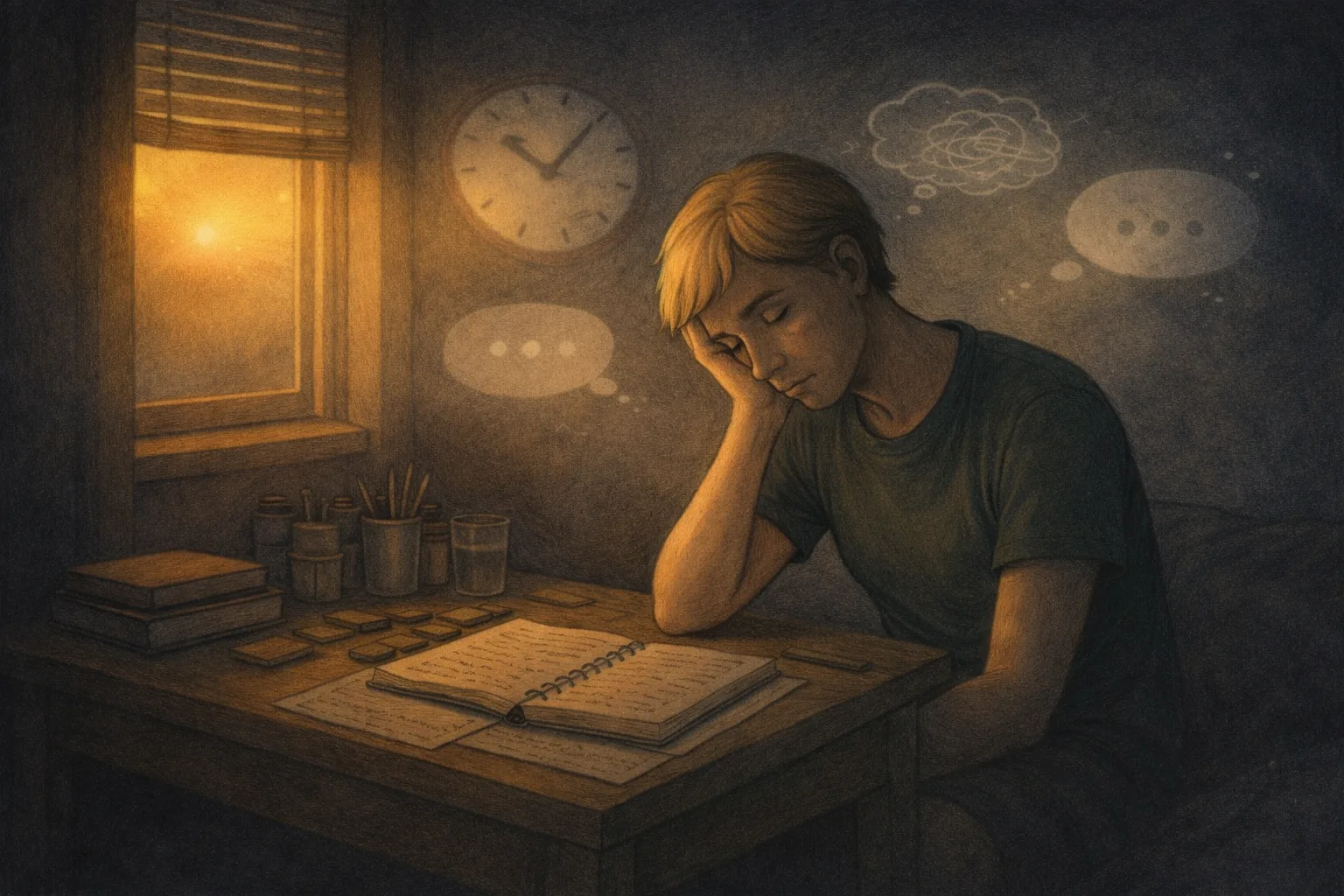
Autistic burnout may seem to occur suddenly. However, it is often preceded by progressive signs. These signs resemble those of burnout once it is fully developed, but they appear more slowly and in a less intense way. They are mainly distinguished by their gradual onset and their milder expression compared to burnout when it becomes fully established. This topic is rarely discussed in the literature, even though it helps warn of an approaching autistic burnout.
In my other articles about burnout, I explained that it often appears suddenly. By that, I meant that the syndrome itself can be triggered abruptly. What few articles explain is that this form of autistic exhaustion has its roots much earlier in the person’s life.
It often corresponds to months, sometimes years, of compensation and adaptation to sensory difficulties. With continued overload, the nervous system eventually can no longer keep up and responds with autistic burnout.
I wrote a complete article on autistic burnout that explores it in detail. This one aims to prevent its onset.
Early signs of autistic burnout
1. Increasing, persistent fatigue
Many autistic people report a fatigue that worsens day by day before the syndrome fully sets in, where it can become extreme.
Nature of the fatigue
This is especially expressed as intense social fatigue: the autistic person finds it harder to socialize as they used to before the signs began. The more burnout develops, the more extreme this social fatigue becomes. This is what first made me realize something was wrong.
I had learned to manage my interactions and found ways to recover. However, just before the onset of this massive crash, I saw my tolerance to social fatigue gradually decrease. A few days later, even a 5-minute conversation could ruin an entire day due to the overwhelming fatigue it caused.
Longer recovery time
After sustained social interaction (and for some, even relatively light interaction), most autistic people need time to recharge. Social interactions require multiple types of effort.
Before burnout, the need for recovery often becomes essential for functioning. It is not yet a complete inability to function, but rather functioning with a heavier and heavier burden. A normally manageable day can become a cognitive, social, physical, and emotional strain just before and during the collapse.
2. Decreased sensory tolerance
Autistic burnout is often described, both in the autistic community and in scientific literature, as altering (sometimes permanently) sensory sensitivities. For many, this is the first sign that something is wrong.
Without yet reaching the level of difficulty caused by full burnout, these changes act as warning signals. While burnout can push someone to strongly isolate themselves from external stimuli, increasing hypersensitivities can often be noticed beforehand.
Sounds become aggressive.
Light becomes more exhausting. Though this can depend on the source: natural light becomes increasingly unbearable to me, while artificial light can feel almost hypnotic.
Looking back, I now make the connection. The first time, however, I simply assumed I was constantly tired, without understanding what I was going through. My hypersensitivities remained manageable, and I could still go outside without too much difficulty.
3. Masking intensifies
In short, whether consciously or unconsciously, an autistic person may reinforce their social mask when they start noticing difficulties like those of an approaching burnout. This is a form of social protection that ultimately worsens the upcoming burnout.
Why masking increases
People will start systematically analyzing their social behavior and adapting accordingly. The main reason: to hide increasingly overwhelming difficulties as much as possible. For many autistic people, masking their traits and differences is a daily challenge that only stops when they are alone.
The masking loop
In an effort to fit in, they end up masking more and more.
The irony: in trying to reduce fatigue, they actually amplify it. Reducing masking therefore becomes necessary to regain a functional state.
I observed this exact pattern:
- Fatigue increases
- Autistic traits become more noticeable
- Fear of others’ perception (not wanting to appear “alien”)
- Increased masking
- Even more fatigue
- Even more pronounced traits
4. Unusual irritability
Before autistic burnout, some people notice unusual irritability. Situations that were previously tolerable suddenly become difficult: a small noise, a conversation that drags on, or a minor unexpected event can trigger a disproportionate reaction.
This irritability is not a personality change but a signal of nervous system overload. As resources decrease, the brain tolerates additional stimuli less and less.
Irritability is also seen in depression or (hypo)manic episodes in people with bipolar disorder. However, the cause is different and linked to mood. In bipolar disorder (and unipolar depression), irritability is driven by internal factors, particularly neurochemical imbalances.
Paradoxically, it was during my autistic burnout that I experienced the most irritability, notably accompanied by strong anxiety. Irritability rarely appeared during my bipolar episodes, except in mixed episodes.
5. Loss of daily functioning abilities
Before autistic burnout, the person or those around them usually notice increasing difficulty functioning in daily life. Organizing and planning activities, or even simple tasks, can become unusually hard. Executive functions begin to be affected: the person may forget to complete tasks, even simple ones, and struggle to organize their day.
What might be seen as laziness is actually a neurological phenomenon aimed at protecting the brain. Difficulties related to executive functions further increase cognitive load.
Before my autistic crises, I become more intolerant of change or unpredictability, but it remains manageable. It creates anxiety, but I still go along with things without pushing back too much. Once burnout begins, even something like someone sitting in my usual seat can trigger strong anxiety or frustration (hello Sheldon from The Big Bang Theory, whom I identified with long before my diagnosis).
Why these signs go unnoticed
Whether for autistic individuals or those around them, these signs often go unnoticed. They are interpreted as the result of intense fatigue rather than a distinct syndrome. Fatigue can indeed produce these symptoms, but they usually disappear after rest.
Everything gets attributed to fatigue or stress, which are typically temporary. This article highlights a key difference: the symptoms persist even after one or several days of rest. By the time the person realizes what is happening, it is sometimes already too late.
A state of overload
Before autistic burnout, many describe a constant feeling of being “on the edge.” Daily tasks seem to require more effort than before, even if they remain achievable.
This feeling can be hard to explain because it is not always linked to a specific event. It often reflects a gradual accumulation of sensory, social, and cognitive fatigue.
Early signs: “on the edge of a crash.”
During burnout: “complete collapse.”
Learning to better understand yourself
In short, overload manifests in a diffuse way across almost all areas of an autistic person’s daily life. These early signs are actually the same as those of burnout. The difference lies in their intensity and frequency.
👉 To understand how burnout manifests once it is fully developed, see also: 10 signs of autistic burnout.
Recognizing these early signs can help you act before autistic burnout fully sets in.
Reducing sources of overload, adapting your environment, or decreasing masking can sometimes prevent the collapse.
But if autistic burnout has already taken hold, recovery often depends on rest, reducing overload, and adapting your environment.
FAQ – early signs of autistic burnout
Early signs include increasing fatigue, heightened sensory sensitivity, a growing need for recovery, and a gradual difficulty in managing social interactions.
Yes, recognizing early warning signs often allows you to act in advance: reducing overload, adapting your environment, and decreasing masking can help limit the risk.
They can appear over several months, or even years, before burnout fully develops.
Early signs are more gradual and less intense. Burnout, on the other hand, corresponds to a sudden collapse of abilities.
