




What is the difference between a manic obsession and an autistic special interest? On paper, the distinction seems simple. In reality, it is not at all. This confusion is common, including between bipolar disorder and autism (ASD), even among healthcare professionals. I have experienced it myself from the inside.
In Brief:
- A manic obsession is a symptom of bipolar disorder: sudden, intense, often irrational and overwhelming.
- An autistic special interest is structured, stable, and helps regulate emotions and make sense of the world.
- Manic obsessions appear abruptly, can become destructive, and take over everything.
- Special interests are long-lasting and part of the autistic person’s identity.
In 2021, I experienced a severe manic episode. Accompanied by psychosis. Two delusions set in: erotomania (a delusion of love) and a mission delusion. After three months of visits with my psychiatrist, after telling him what I had in mind, he asked me: “But why didn’t you tell me about this earlier?”. Why? Because I didn’t feel the need to describe to him how I was going to save the world by becoming an “extreme environmentalist”. This idea flooded those around me with messages, but it was mistaken for a simple special interest. And yet, it was something entirely different.
When I started this manic episode, within a few days, I became passionate about ecology. If you imagine a Greta Thunberg v2.0, you’re imagining it wrong. It only took a few hours for me to completely snap and imagine myself capable of solving the world’s ecological problems by becoming the best environmentalist version of myself. A few days later, I was talking about nothing else. I was sorting waste in an extreme way, picking up bottle caps in the street, deleting my files from my cloud, and refusing to take planes (hey, luckily, I didn’t have the money or the opportunity to do so anyway). I was reading everything I could find about ecology on the internet and felt more inclined to talk about it than my best friend, who was finishing her studies in environmental law. I’m not exaggerating when I say I snapped. Everyone saw it, and apparently everyone was fed up, but I was focused on my mission.
Autistic special interest: a structuring passion
What happened is that I entered a full mission delusion. Meaning that I believed I was destined to accomplish something, and that I was the only one who could do it. During a manic episode, one can naturally get involved in a cause to the point of becoming obsessed with it. This is where a difference with an autistic special interest appears.
A special interest is not an obsession; it is often a very intense passion that serves emotional and sensory regulation. It has a beneficial role in the life of an autistic person. It is not normally harmful, but it can become overwhelming in conversations. The difference is that it becomes so due to a lack of understanding of social interactions. Without a manual, an autistic person may infodump on those around them without being concerned about how it comes across.
Manic obsession: a symptom of bipolar disorder
It is different. In mania, you enter a vicious cycle where you become fixated on only one thing (or several), and that thing often becomes rooted in grandiose ideas or delusions. I’ve lost count of how many times I suddenly became passionate about a subject because I was manic. However, I didn’t engage with it in an autistic way. It was superficial, skimmed over, or quickly forgotten. Yet I was involved in that subject more than I would ever have been with a special interest. It became part of my identity, often part of a mission that some external force had assigned to me.
Obsession with Titanic
To give a few examples: I went from watching romance movies to better learn how to analyze nonverbal cues, to watching Titanic every day instead of sleeping for nearly six months. I was completely fascinated by Cameron’s camera work and lighting, and the film became part of my daily routine. I stopped counting the number of viewings after a hundred.
Obsession with MIT (and becoming rich)
At the same time, I made it my mission to get into MIT (what I saw as the most prestigious engineering school in the world). Why? To enter Silicon Valley, become rich, and solve problems like world hunger. MIT quickly became my one and only goal, setting aside my high school studies, letting my grades plummet, but throwing myself into numerous projects that would have opened the door to that school.
I was deep in delusion. I had nothing else in mind, forgetting everything else. A special interest would not have made me forget to eat or get some rest (to that extent). MIT caused all of this. I was so obsessed with the subject that I would tell all my irrational stories to anyone who let me speak for a few seconds.
Obsession with outperforming an engineering cohort in programming
Later, this time in hypomania, I took part in a very intensive three-week programming “bootcamp,” where you had to code almost day and night. I performed extremely well, to the point of clearly standing out from the rest of the cohort of around 200 students. While I was barely sleeping, I simply put my skills at the service of those three weeks and crushed almost every challenge that came my way. I had never been so challenged, but I was so activated that I gave everything I had, pushing my performance beyond anything I had ever done before, impressing those around me (at the cost of a certain depression that would follow).
Programming was one of my special interests, but it turned into a real manic obsession. No normally functioning person could have lasted three weeks with two to three hours of sleep and such relentless effort to complete every exercise… without experiencing the slightest difficulty. I was body and soul in this mission to succeed in those three weeks. It was irrational, once again. I was destroying my body without realizing it, not taking a single second of rest. All of this while spending half my evenings partying. A hypomanic feat—not recommended.
Manic obsession, irrational
This is where the subtlety with special interests lies. A manic obsession is not just intense. It is completely irrational, as you will have seen from what they all have in common. It starts from an idea, and spirals completely out of control by anchoring itself in such a way that it defies understanding, and invades the person in all their conversations. My friends still remember that MIT saga when we were still in high school. I talked almost only about that. And when I talked about something else, it was about my projects. Except I also had special interests at the time.
A confusion that is difficult to perceive
And that is where the whole difficulty came from in realizing that I was not doing well at all. I was still talking about my special interests, which had not disappeared. Those were not irrational, but they were still overwhelming. At the time, I spent my time installing “custom ROMs” (custom versions) of Android on my phones, which then blended with my manic obsessions. It therefore became difficult to distinguish what was only temporary from what was truly part of me.
My mother became alarmed, but my father simply told her that I was “more myself.” In a sense, he wasn’t entirely wrong. When I am manic, I am not completely someone else. I am a ++ version of myself. That can be confusing, and misleading.
The difference explained: manic obsession vs special interest
In the most concrete way possible, it is important to more clearly describe the difference between manic obsession and special interest.
A structuring special interest
My interest in custom ROMs did not come out of nowhere. It was part of a very intense interest in new technologies and computing more generally. When I discovered that I could modify the deepest parts of my phone’s system, I felt great joy to the point of testing several, sometimes multiple times a day.
I enjoyed discovering pure Android versions and confronting the many bugs caused by the amateur nature of the process. A “System process has stopped working” amused me more than it frustrated me. I felt compelled to test the entire system, to make it crash myself. It was a fascination with a new world. I dreamed of developing these custom ROMs myself (but I was manic, so I never took the time, too busy). In a world with a shaky and unpredictable structure, I was learning to understand an architected system, one that was comprehensible to my programmer’s eye. Nothing happened randomly, everything had an explanation. It was the structure I was missing.
Why special interests structure the autistic world
More broadly, this is what programming brought me. Nothing was truly surprising. No bug happened by chance. There was always an explanation, you just had to have the eye to understand it. This structured world, governed by explicit rules, rules that never changed or that came with guides, was the world I dreamed of. So I immersed myself in it radically, to the point that it looked like an obsession, when it was simply a way of learning to navigate the world differently. In computing, I was master of my code. In the social world, I was a slave to constant ambiguity. Ultimately, there was a real, useful intention for my functioning in these two interests (and all my special interests).
Manic obsession, without function
There was none in the manic obsession. It systematically arose from an incongruous idea that became the center of my world. It was destructive (notably because it deprived me of sleep). It is a warning signal. I exhausted all my friends with my ecological obsession, with my obsession with sports, with the inflated self-esteem that stemmed from my performance in computing. I didn’t lose anyone, but interactions were damaged, without me even realizing it. Today, people know. They know how to warn me. But as always with mania, most of the time, I don’t care. That’s the danger.
The special interest builds.
The manic obsession destroys.
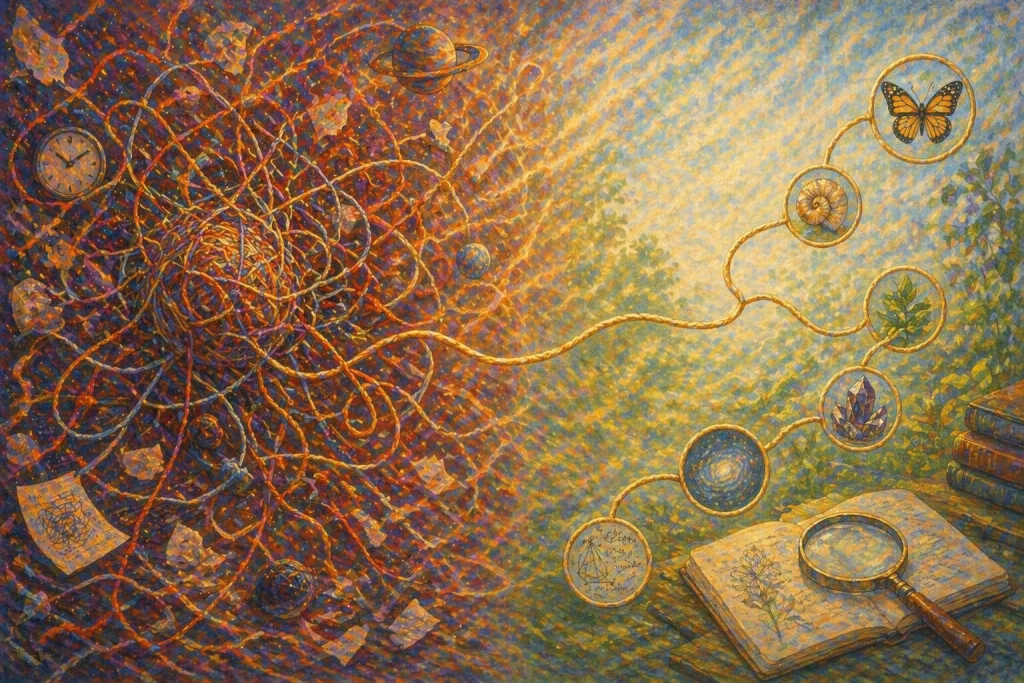
The confusion between manic obsession and special interest
A word on one of the reasons that leads psychiatrists to make misdiagnoses between these two conditions. Many autistic people are mistakenly diagnosed with bipolar disorder, as their special interests can be confused with manic symptoms. The reverse also happens: a patient deeply caught in a manic obsession may be mistaken for an autistic person. The difference is so subtle that with one appointment per month between the patient and the psychiatrist (on average), mistakes can happen quickly.
The difficulty is even greater when the patient presents both conditions, and it then becomes necessary to disentangle what comes from which.
This is why I wrote this article: to offer my version of what I experienced and to try to clarify the nuance—subtle, but important to make. I hope this will help guide my readers so they can be better oriented. And I also hope it will encourage specialists and those around them to listen more carefully, and avoid confusion. A manic obsession is a symptom of a critical episode; a special interest is more often a vital function for an autistic person.
Understanding the difference between manic obsession and autistic special interest is essential to avoid misdiagnoses between bipolar disorder and ASD.
FAQ
A manic obsession is linked to an episode of bipolar disorder and can be irrational, whereas an autistic special interest is structured and long-lasting.
Yes, both can coexist, which makes the distinction between obsession and special interest more complex.
Because both can be intense and overwhelming, especially during infrequent consultations.
