



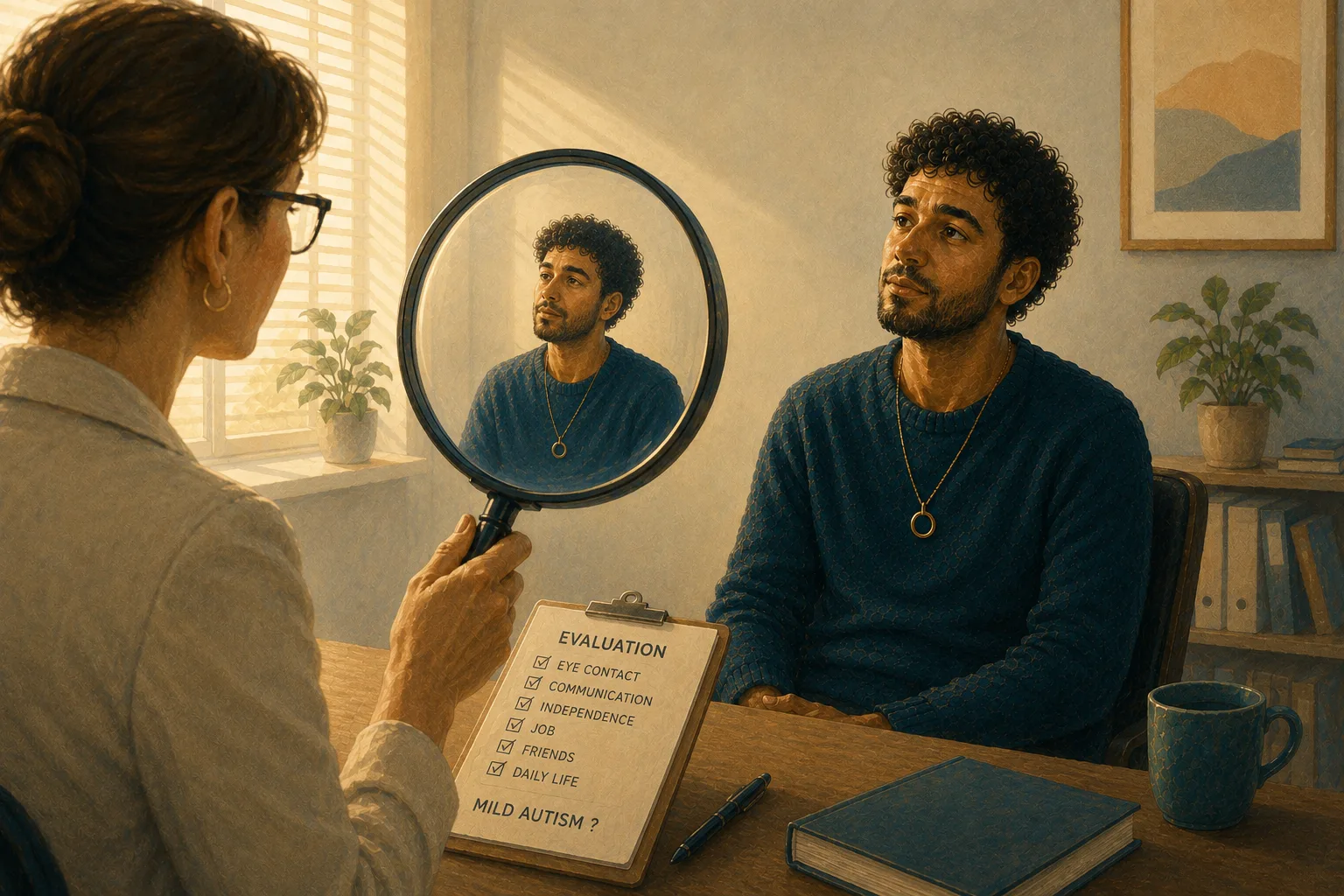
Outdated ideas about autism remain widespread, including among some professionals. Recently, a psychologist subjected me to an interrogation that dismissed my lived experience as an autistic person by comparing me with “severely” autistic people—in her own words. What she said was particularly violent. For nearly thirty minutes, she questioned my diagnosis and my experience using a very dubious line of reasoning built on a whole collection of misconceptions. I am going to examine them in this article.
In short:
- Context: a psychologist questioned my diagnosis by relying on several misconceptions about autism that remain widespread.
- Misconception no. 1: sharing a few traits with autistic people does not mean being “a little bit on the spectrum.”
- Misconception no. 2: support levels are not degrees of autism ranging from mild to severe.
- Misconception no. 3: independence, speech or having friends are not enough to assess an autistic person’s difficulties.
- Key point: current classifications describe autism as a multidimensional spectrum, with support needs that vary across domains.
- Aim of this article: to examine these misconceptions in light of current knowledge and explain why they can invalidate autistic people’s lived experiences.
When everyone is “a little bit autistic”
The discussion began with a surprisingly serious claim for a psychologist to make: we are all a little bit on the autism spectrum. Coming from a trained psychologist, the claim may seem surprising. But perhaps it is not so surprising after all: autism still receives relatively little attention given its complexity, and the knowledge being taught is not always up to date.
I took the time to challenge this idea, trying as best I could to explain why it was false, reductive, minimizing and, above all, dangerous. She told me that everyone could stim, using herself as an example, or have routines.
Stims are not merely habits
I quickly put a stop to that: stims are behaviors used for self-regulation. Anyone can stim. In autistic people, however, stims are far more central and frequent, and they correspond to specific diagnostic criteria defined in the DSM-5.
As for routines and rituals, we would be more likely to call them habits in the general population. The difference is that some autistic people can experience significant distress when they are interrupted. Anxiety spills over. It is as though chaos has suddenly been introduced into the autistic person’s life.
We speak of a spectrum because every autistic person meets criteria in the same broad diagnostic domains, but with highly variable manifestations, combinations and consequences. Displaying a few isolated traits associated with autism therefore does not mean that someone is themselves “a little bit on the spectrum.” A specific number of symptoms described in the DSM-5 must be present.
Why this idea is dangerous
According to her, saying that everyone works in the same way would help avoid stigmatizing autism. Yet this is dangerous precisely because it ignores how pervasive these difficulties can be for autistic people—and how they are stigmatized because of them.
Downplaying those differences is simply counterproductive. The goal should not be to pretend that we are all in the same boat, but to accept both typical and atypical ways of functioning across every form of cognitive difference.
A psychology degree as an appeal to authority
A quick aside about the psychologist’s almost compulsive need to mention her degree every other minute. This was an appeal to authority, which has no value in a debate. A degree does not prevent someone from saying foolish things. What matters is keeping one’s knowledge up to date or being able to admit when a subject lies outside one’s expertise. My own psychologist did exactly that when she felt she could no longer provide the help I needed.
Unfortunately, this psychologist never questioned herself. She kept insisting that she worked with “severely autistic” patients and therefore knew what she was talking about.
(Bad luck: so do I. I even run this blog about the subject.)
“Severely autistic” people
Her argument ultimately consisted of repeatedly asserting that there were degrees of autism: some people were severely autistic and therefore more autistic than other autistic people. That was indeed the commonly accepted view, including in psychiatry—thirteen years ago, before the DSM-5 was published and brought all forms of autism under a single diagnosis: autism spectrum disorder.
I tried to explain that I knew some views within healthcare remained very close to those that existed before the DSM-5.
Very high support needs undeniably exist. But reducing them to an overall quantity of autism ranging from mild to severe conceals the diversity of people’s abilities, associated disabilities and support needs.
Support levels are not degrees of autism
There are, however, specifiers that can be added to a diagnosis. A psychiatrist may state whether an intellectual impairment is present and assign a “level.” These levels range from 1 to 3 and describe how much support a person requires. The American Psychiatric Association defines them in a dedicated document.
According to her, level 3 was simply a nicer term for severe autism. Today, level 3 does describe difficulties that are often much more apparent and may correspond to what was called “severe” before 2013, or to certain forms once described as “Kanner autism,” for example. Those diagnostic labels no longer exist.
Why the DSM-5 abandoned that classification
Why? Quite simply because specialists considered that those categories did not accurately reflect the reality of autism.
Two autistic people can display the same visible behavior, such as a meltdown—screaming, crying or hitting one’s head can occur across the autism spectrum—while having very different abilities, independence and support needs. Conversely, someone considered highly independent may experience extremely significant difficulties in certain areas.
One paper specifically confirms that the “severity” of autistic features and overall disability are not the same thing: adaptive skills, intellectual disability, anxiety, epilepsy and a person’s environment can all substantially alter their daily difficulties (see Waizbard-Bartov et al., 2023).
This is precisely why placing autism on a single axis from mild to severe is reductive.
“Neurotic anxieties”
She then changed the subject. To support the idea that my autism was less significant, she asked whether I experienced impossible anxieties, which she called “neurotic anxieties.” The first problem is that this term no longer means much today—and comes from the psychoanalytic tradition, which is frequently criticized in the context of autism.
The second problem is that the intensity of someone’s anxiety is not tied to the nature of their autistic difficulties. She may have worked with autistic people with limited independence who showed this kind of anxiety more visibly. But anxiety is a major co-occurring condition across the entire autism spectrum. A meta-analysis of more than 26,000 autistic adults estimated that approximately 42% had experienced an anxiety disorder during their lifetime.
The third problem is that she was describing these autistic people’s anxieties even though some of them may not have had the ability to communicate their experiences accurately to the people around them or to professionals.
The myth of “severely autistic” people being “in their own world”
Her argument then became difficult to follow. When she talked about these autistic people, she described those who were “in their own world” and supposedly unaware of the world around them. This is a common perception of some autistic people. People sometimes say that they are “in their own bubble.”
She pointed out that I could talk and communicate with her, contrasting me with autistic children who stare at the ceiling while someone speaks to them. Except that many autistic people did this as children—and may still do it.
It is not necessarily caused by an inability to hear or understand the outside world. It is often a sensory fascination connected with sensory differences, which affect up to 90% of autistic people (see also Luigi Balasco et al., 2020). As a child, I watched dust particles for hours, including while people were talking to me.
The case of Temple Grandin
I gave her the example of Temple Grandin, the renowned autistic author of Thinking in Pictures, who revolutionized the cattle industry worldwide—something the psychologist called “cow culture.” She dismissed my point by reducing a thoroughly legitimate autistic woman, who was non-speaking until the age of five, to that phrase and even questioning her autism diagnosis.
At that point, I was laughing bitterly as she assured me that I was “mildly autistic,” even though I was only just beginning to notice the cognitive and sensory overload building inside me.
The interrogation I had never seen coming
Questions about my independence
She then changed tactics. As though she had the right to do so, even though I was not her patient, she began questioning me about my independence in an attempt to demonstrate how well I functioned. These were her next questions:
- “Do you work?” → No, and I have never managed to keep a job for more than a few months.
- “Did you earn your degree?” → Yes, because my mother stepped in when I was about to fail my two-year post-secondary qualification, and my teachers practically handed me the diploma.
- “Do you have your own apartment?” → Yes, and my parents and disability allowance pay the rent.
- “Do you do your own grocery shopping?” → My mother does half of it because I do not feed myself properly.
I could see that she was running out of material, so she ultimately fell back on one final, equally absurd question: “Yes, well, at least you have friends, don’t you?” Yes—but that is not a diagnostic criterion. All my autistic friends have a few friends, regardless of the difficulties they face. And above all, before 2013, many people diagnosed with Asperger syndrome—and therefore described as “high-functioning” at the time—had no friends then and still have none today.
The question was therefore beside the point.
A reductive view of independence
The reality is that independence is another dimension of the autism spectrum, and many people who appear to function well have varying degrees of difficulty living independently. None of the questions she asked described the “severity” of my autism. At most, they attempted to describe certain aspects of it.
It was simply rather ironic that she chose almost exclusively questions whose answers contradicted the point she was trying to make.
Non-speaking autistic people
A brief point on this subject: when she spoke about children who were unable to communicate—yet whose anxieties she somehow knew—she was actually talking about non-speaking autistic people with intellectual disabilities.
I rarely discuss this on the blog because it is not part of my own experience. Nevertheless, it is worth remembering that for decades, non-speaking autistic people were assumed to have an intellectual disability.
Non-speaking does not mean intellectually disabled
We now know that these are two different things. Autism and intellectual disability do overlap, and this combination often results in more visible autistic traits. But non-speaking autistic people do not necessarily have an intellectual disability. Some have even written books about their experiences, including Ido Kedar and Naoki Higashida. Their accounts obviously cannot be generalized to everyone concerned, but they remind us that speech alone cannot measure understanding.
More importantly, describing either group as “severe” is brutal and can be extremely harmful to hear. This psychologist works with autistic children who have these characteristics and who hear the language she uses. Many autistic people in this situation, and sometimes their families, have said that they do not want the phrase “severe autism” used because it casts them as the “bad autistic people.” Is it not time we listened to the people concerned?
The analogy with levels of depression
In one final failed attempt to discredit my argument, she brought up degrees of depression. It is indeed common, including in psychiatry, to speak of mild, moderate or severe depression.
In practice, the analogy does not work. A depressive symptom scale measures a relatively unified set of symptoms present at a particular time. The PHQ-9, for example, distinguishes levels of depressive symptoms using thresholds corresponding to mild, moderate, moderately severe or severe depression.
In autism, a score or level related to core features does not necessarily summarize someone’s independence, co-occurring conditions, intellectual abilities, sensory differences or overall support needs.
There is no equivalent single scale for autism, and many personal accounts have shown that autistic difficulties vary considerably across several dimensions.
What I took away from this discussion
I eventually decided to leave and escape a conversation that was clearly going nowhere. We were going around in circles. I felt that she was mainly trying to defend a position that did not stand up to scrutiny. I realized the discussion was no longer going to lead anywhere.
I was subjected to a speech that invalidated my experience and my difficulties, along with a glaring contradiction: she tried to reassure me by saying that she was not invalidating me—immediately before beginning an interrogation.
I managed to remain calm—almost until the end—which is something I would have struggled to do a few years ago.
Being a professional does not make someone all-knowing. What matters is recognizing that and being willing to question one’s misconceptions. I did not manage to change her mind this time, but I hope she will eventually reconsider her views rather than continue passing outdated representations on to autistic people and their families.
