




Autistic humour can take many different forms: wordplay, absurd humour, dark humour, irony, or the deliberate use of literalness. Many autistic people also have a particular relationship with words, which can become an important source of humour. I’m one of them. Twisting their meaning, deliberately interpreting them literally, playing with words, or letting them drift into the absurd. Others play a lot with irony, while dark humour can sometimes create a rather spectacular disconnect with the people around them. I see myself in all of these forms.
I share all of these forms of humour. Even irony, despite sometimes having difficulty understanding it when it doesn’t come from me. I was duly trained by the people around me until I learned to master it myself. It isn’t my most typical form of humour, but it comes just as naturally as my fondness for the absurd or very dark humour.
And this relationship with humour is not uniform among autistic people: how humour is detected, understood and used varies depending on the type of humour and the situation (see the systematic review by Mention et al., 2024).
Dark humour that goes too far
It can trigger “waaaah” reactions or comments — often themselves ironic — about how I’ve gone too far. I’ve had to learn to carefully calibrate these flashes of humour, especially because I often keep a very poker face expression, which can make people think I’m being completely serious. I do lack a little inhibition, though, and can sometimes fail to properly assess a situation in which I would have been better off keeping my mouth shut.
One example came to mind after watching a film about someone who had been tortured in prison: I asked whether torture really worked on everyone because “some people are into BDSM.”
Consider yourselves warned, and perhaps this will help you better understand those flashes of humour from your autistic loved ones that can provoke surprise — or contagious laughter. I try to follow “you can laugh about anything, but not with everyone” as literally as possible. Except that, with me, sometimes, “I can laugh about anything, but with no one.”
Stereotype-based humour
Not to be confused with a joke that relies solely on putting down a particular group. What usually amuses me here isn’t the stereotype itself, but rather twisting it, exaggerating it, or making it absurd. Stereotype-based humour is simply about playing with… stereotypes.
That’s why I have several friends with whom I play around with culture, often precisely because I openly admit that I have absolutely no idea what I’m talking about (which also brings us into self-deprecating humour, my third favourite kind). Sometimes I even invent stereotypes or borrow other people’s. I lived in the mountains for ten years, with a forest right behind my fence, yet I love calling anyone from Lyon or Marseille a country bumpkin. In fact, it isn’t the stereotype that amuses me; it’s the absurdity of the sentence itself coming out of the mouth of someone who used to live in the middle of the woods.
Wordplay
I love wordplay. Especially when I notice unintentional wordplay in what other people say. But I make puns too, particularly during manic episodes — and in my head. For instance, in August 2026, I was sitting on my couch watching Finding Nemo when I started thinking about fishermen, then suddenly wondered: “Do farmers have meatings?” (I’m French, so I’m kinda proud of that one.)
Neologisms and portmanteaus
I also love making up words, especially when two sounds or ideas seem to fit together in a way that shouldn’t quite work. Sometimes the result is a portmanteau, sometimes just a word that feels like it ought to exist. That tiny moment where nonsense suddenly starts sounding linguistically plausible is exactly what I enjoy.
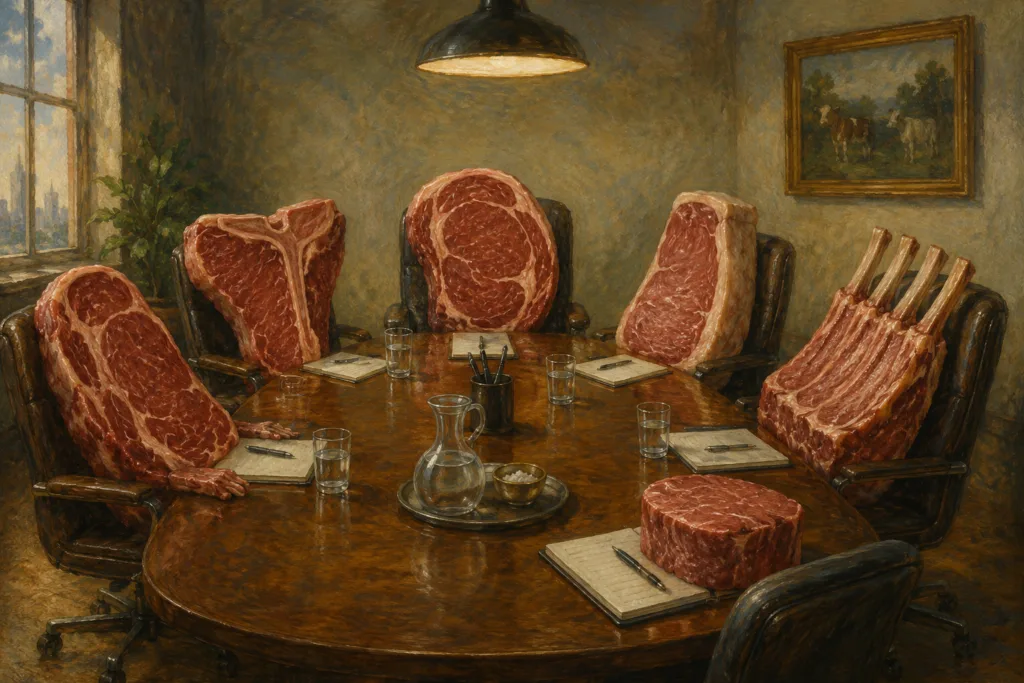
Absurd humour
And that brings me to my favourite kind of humour: the absurd. I can start from a perfectly ordinary situation and shift the perspective until the whole thing becomes ridiculous.
I once replied to a video of a Parisian woman who had moved to the South of France and was complaining about being woken up by roosters and hearing cicadas everywhere:
“I come from Guadeloupe, and when I moved to Paris, I was kind of disturbed by the lack of chickens to wake me up. I had to install an alarm clock. And the cicadas were weird too — all day long, they sounded like crazy car horns. I missed my forest, but at least there were a few trees along the road to school. I wanted to go back.”
Sometimes it can also be much shorter. Someone once asked whether an Earth with its continents and oceans reversed would still be habitable. The waves in the image were visible from space, so I logically replied:
“Considering the fact that we can see the waves from outer space, I’d say we’d be pretty fucked pretty quickly.”
Being deliberately very literal
I’ve already talked about this on the blog, but when the trailer for Avatar 3 came out, it was only being shown in cinemas. So I told people, “I’m going to the cinema on Wednesday morning to watch the Avatar 3 trailer,” without giving them any more details. It was deliberate: taken literally, it meant exactly what I was saying. I was only going to the cinema for the trailer. I hadn’t said which film I was going to see simply because I intended to leave the theatre after the trailer.
Since I’ve only had autistic people in my social circle for the past few years, I haven’t had many opportunities to observe this tendency. But it does exist, and I’ve heard an autistic friend several times having fun with the literal meaning of a sentence. There’s something almost ironic about this kind of play shared by many autistic people, given how often they’re criticised for taking things too literally (see the meta-analysis by Kalandadze et al. on figurative language in autism). You want literal? Here you go!
Learning irony… then playing with it
I’m sometimes criticised for taking things too literally. The reality is that I’ve spent years learning to understand irony. Sometimes with a slight delay, but often very quickly. Here’s how I learned to operate: interpret any nonsensical or illogical statement as a possible form of irony, rather than as a mistake or a lie from the person I’m talking to. Taken to an extreme, this also meant I sometimes failed to recognise (hurtful) mockery when I was a student. The rest of the time, it works. Which is why I couldn’t help laughing when a friend replied, “You’re lying to me,” after I’d said something ironically. Literally, she was right: I had stated something I didn’t actually believe. Pragmatically, of course, it wasn’t a lie, because irony specifically relied on her understanding the discrepancy.
So I learned to use irony and share a more conventional kind of humour with my peers, which I nevertheless find very funny. But I have one particular trait: I can get caught up in elaborate personal jokes that can go on forever. I’ve said it in other articles: for me, humour is meant to make me laugh. Great if it works for the other person; too bad if it doesn’t. So sometimes I’ll start a joke, dive completely into it, let it drift and build an entire world of my own, until the humour that began with a simple bit of irony starts shifting between different forms: absurdity, dark humour, constructing an alternative reality.
When a joke becomes a world
I’m going to tell a little story (while trying to avoid the autistic tendency to include unnecessary details). This happened while I was talking with a friend with bipolar disorder. It all started with a deliberately exaggerated caricature: “patients used to get restrained because they were too happy.” We spiralled from there, imagining that you could get restrained for being happy about nice weather, then simply for liking flowers, or even a blue sky. Anything could become an excuse to lock people up, with only one possible outcome: only the supposedly ill people would remain outside.
Then we took it further and said that psychiatrists themselves would have to be locked up because they restrained too many people. People with bipolar disorder would be left outside, all completely delusional, trying to rule the world and believing they had superpowers. We imagined a world ruled by madness, with completely arbitrary laws, shaped by bipolar people, for bipolar people, but in absolute chaos. I was in the middle of a manic episode at the time, and I was responsible for most of this nonsense, which sent both of us into a fit of laughter that was difficult to stop.
When faced with unusual autistic humour, a surprised reaction doesn’t necessarily mean that something has gone wrong — and an awkward joke doesn’t necessarily reveal questionable intentions. When the context allows for it, trying to understand the logic behind it can be more interesting than stopping at the initial disconnect. Let yourself be carried into that person’s inner world, just as they themselves are often trying to be carried into yours.
Humour as a way of thinking
Humour is also a way of thinking, perceiving, and transforming the world. For autistic people, it can take unusual forms, surprise or confuse others, while still following a perfectly coherent logic for the person producing it.
When bipolar disorder gets involved
For me, however, it isn’t solely related to autism. Bipolar disorder can radically transform it: during a manic episode, my humour becomes pervasive, associative, and almost euphoric; during a depressive episode, it becomes darker, more cynical, and sometimes even disturbing. I explore these two sides in Mania and humour: when everything becomes funny and Depression and humour: when laughter turns dark (available soon).
And if you recognise yourself in this article, feel free to share your own flashes of humour or awkward moments: no one will judge you here.
