



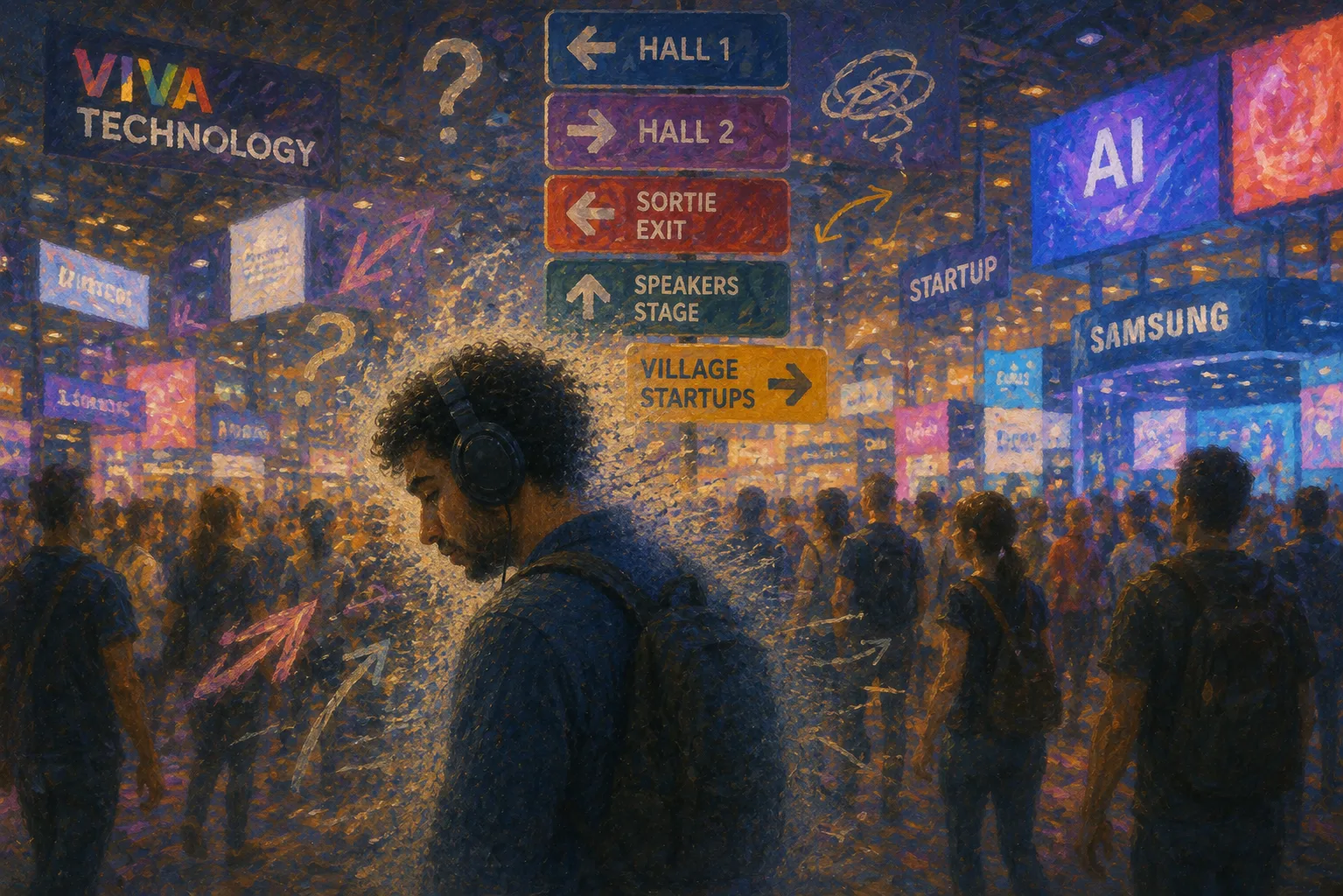
An autistic shutdown can occur when an accumulation of sensory, cognitive and social stimuli exceeds a person’s processing capacity. The brain then slows down abruptly: speaking becomes difficult, even the simplest decisions become impossible, and the body may keep moving on autopilot. In June 2026, VivaTech was held in Paris—a kind of French mini-CES. I had been looking forward to it, hoping to hand out résumés and potentially land a job. I had not counted on a massive shutdown beginning before I even entered the exhibition.
I have already written several times about my autistic crises, but I thought this one was particularly interesting because it was triggered so quickly, without me realizing it.
On the day of the event, I go through my usual daily routines and prepare as best I can—or at least as well as I think I can. That is where the first problem arises. I have never attended an exhibition like this before, yet I ditch the jeans and shirt because the weather is so hot.
The first cognitive overload: getting lost on the way to VivaTech
I set off around noon, planning to spend the afternoon there. The second problem: I have never been to Porte de la Villette, where the event is being held. I arrive by metro and emerge into complete calm. I can see a gathering farther away, but there is no information about the exhibition. I walk around the area twice, then three times, before looking up directions on the official website. But the route takes me to another entrance that I cannot access.
Asking for help: one more effort
Panic begins to set in, though I do not understand it straight away, so I call my mother for help. Mistake: she reacts by getting annoyed, as people often do when I ask them for help, even though asking for help already takes a great deal out of me.
I hang up.
I go back into the metro to try again from the correct exit.
By this point, I am already beginning to operate entirely on autopilot. Where many allistic people would see a minor setback or consider a different route, I have just expended a huge amount of effort that I could have avoided—and it has triggered severe fatigue.
The first signs of shutdown: operating on autopilot
I am no longer thinking about what I am doing at all. A mental fog has settled in, and on top of that I have to contend with poorly marked directions, thousands of people, and a multitude of signs and directions that contradict one another. I still have my headphones to muffle the noise, and eventually I manage to enter the exhibition purely by chance, following the flow of the crowd.
Inside VivaTech: sensory overload
I keep moving forward, still in a haze, feeling increasingly overwhelmed by the sheer number of booths in different sizes: sometimes a simple display with someone presenting a startup, sometimes a larger panel, and elsewhere enormous installations such as Samsung’s, with its animated walls. It is beautiful, but I can barely process what is happening to me. I no longer know where to go and simply wander around, with no clear directions or instructions to follow.
I notice that I can no longer speak, especially when I come across two young women blocking my path and instinctively give them a gentle push to get past. I cannot apologize or ask them to let me through.
Leaving the exhibition after just five minutes
Eventually, I leave the exhibition entirely on autopilot. I must have stayed for five minutes. I retrace my steps, trying to find my way (I will explain my difficulties with spatial orientation in a future article), and reach the metro completely overwhelmed, with tears in my eyes. I have only one thought in my head: finding refuge in a quiet bar, having a small drink, because I am afraid I will collapse before I get home.
On the metro, a man has decided to take up two seats, sprawling across both as though basic manners did not apply to him. The problem is that the fabric of his T-shirt burns my arm every time the train moves. My sensory hypersensitivities are flaring up. Yet the idea of standing to escape this torture does not occur to me. In hindsight, standing up might only have made things worse by exhausting me even further.
Understanding what caused my autistic shutdown
I finally get off the metro and realize that I have just experienced a shutdown—the most intense one I have experienced in months. It was less dramatic from the outside, because I was on autopilot and could still move even though I was not aware of it, but more intense on the inside. And I had no way to isolate myself.
Looking back at the chain of events, I can imagine that the heat and excessive sweating during that June day in Paris sealed my fate. Everything else followed: each additional problem became one more stimulus for my brain and body to process.
Being lost and trying to find my way: cognitive overload.
Not knowing how to navigate an unexpected situation: cognitive overload.
The world around me at the exhibition: social and sensory overload.
After the shutdown: a recovery that is still disrupted
The bar: another unexpected setback
When I leave the metro, I feel myself slowly coming back, but I still cannot speak. I head to my usual bar… closed. I was on the verge of another episode when, fortunately, my other regular bar turned out to be open. I buy cigarettes to calm myself down (even though I almost never smoke) and order my pint of IPA, using the few words I can manage to get out.
The cinema: my haven of peace, ruined
The shutdown gradually comes to an end, so I go to the cinema to see a film I had been looking forward to for a long time, Backrooms. The screening is a disaster: phones lit up, people talking constantly. I consider leaving the theater, but that would mean making my way past seats that are all occupied because the screening is full. I still manage to enjoy some of the film, then finally go home, collapse, and sleep for more than 14 hours straight.
Shutdowns are never pleasant for an autistic person. But they are often a protective response by the brain, helping protect it from an overload it can no longer process. This time, the day was simply an accumulation of unexpected events and sensory stimuli that exceeded my ability to manage them.
